

Football likes to tell us that talent is all that matters.
It isn’t.
Money matters. Where you grow up matters. Whether someone can drive you to training matters. Whether there is a team near your home, a pitch you’re allowed to use, a changing room with a working shower. And for generations of girls, simply being allowed to imagine a future in the game mattered most of all.
The latest season of Ted Lasso understands at least part of that story.
A closet with one shower
In its fourth season, the show sends Ted back to Richmond to coach something new: the club’s women’s team, starting out in the second division. The first time he meets his players, it’s in a changing room the size of a cupboard. It has a single shower and a single toilet, and they share it on some days with the youth academy.
It’s played for laughs, the way Ted Lasso plays most things. But the details are carefully chosen. One of the new players is a centre-back who is also a single mother, fitting football around childcare and everything else. Scenes like these make the same quiet point: these women aren’t short of talent. They’re short of everything around it.
The show doesn’t frame any of this as a story about class. But put those scenes side by side and a question surfaces. How much of how far you go is decided by where you start?
Real football has a better answer than fiction does. It begins about 25 kilometres from Barcelona.
The girl with the bruises
Alexia Putellas was born in 1994 in Mollet del Vallès, a working town in the Vallès Oriental. Like many girls of her generation, she learned to play in the school playground, with the boys, on concrete. She has said her mother eventually signed her up for a club mostly so she would stop coming home with her legs covered in bruises.
There was no girls’ team in Mollet. The nearest option was CE Sabadell, in the next town. When she was about seven, her aunt took her to the trial on the back of a motorbike. The club’s president at the time later recalled that it was obvious within minutes that this girl was different.
Being different didn’t mean having a place to play. There were no other girls her age at Sabadell, so she trained and competed with players around 13. She spent much of her time on the bench, building castles out of the sand at the edge of the pitch.
This is the part of the story that talent-only narratives skip. A two-time Ballon d’Or winner started her career because an aunt had a motorbike, a mother was tired of bruises, and a club in a neighbouring town happened to have a women’s section. Change any one of those and the story may never have begun.
Coming home
She had been a Barça supporter since childhood, travelling to the Camp Nou with her father and the supporters’ club from Mollet. Her path back there was not straight. She passed briefly through Barça’s youth ranks, spent years at Espanyol and then a season at Levante in Valencia, where, at 18, she lost her father after a long illness.
In 2012 she returned to FC Barcelona. At the time, women’s football in Spain was semi-professional at best: small crowds, little coverage, salaries that rarely allowed anyone to live from the game.
What followed is one of the great transformations in modern sport. Over 14 seasons, Barça Femení went from a modest section of a men’s club to the most dominant team in Europe. The club won its first Women’s Champions League in 2021, then more. Alexia became the first Spanish woman to win the Ballon d’Or, in 2021, and won it again the following year. That was despite a knee injury that kept her out of an entire European Championship. She left the club as its all-time top scorer, with 232 goals in more than 500 matches.
Those numbers matter less than what changed around them. Crowds of tens of thousands at the Camp Nou for women’s matches. Girls in Alexia shirts in school playgrounds across Catalonia. Teams for girls in almost every town, including, eventually, towns like Mollet.

The paradox of 2023
In August 2023, Spain won the Women’s World Cup in Sydney. It should have been the triumphant peak of a generation’s work.
Instead, within minutes of the final whistle, the celebration was overtaken by something else. During the medal ceremony, the president of the Spanish football federation, Luis Rubiales, grabbed forward Jenni Hermoso’s head and kissed her on the lips without her consent. A Spanish court later convicted him of sexual assault.
The players’ response became a movement under the name #SeAcabó, “it’s over”. Under mounting pressure, Rubiales resigned within weeks. But the players didn’t stop at one man. Represented by their union, FUTPRO, they negotiated directly with the federation and the government’s sports council, and won a commitment to structural change, including the removal of senior federation officials. Alexia Putellas was one of the three captains who signed the agreement.
That same month, the players of Spain’s top league went on strike and won something less visible but just as important: a significant rise in their minimum salary. For many of them, it was the difference between playing football and being able to live from it.
It’s an uncomfortable chapter, but an inseparable one. The generation that won the World Cup had spent years fighting not only for pitches and salaries but for respect from the institutions meant to represent them. In 2023, they got some of both.
When the money arrives
Today, women’s football has the investment, broadcast deals and full stadiums it spent decades fighting for. Even Ted Lasso, one of the most-watched comedies in the world, has put a women’s team at its centre.
That creates a new question: can women’s football grow without rebuilding the barriers that shut people out of the men’s game? Ticket prices that price out families. Matches locked behind subscriptions. Academies that favour those who can afford the travel and the kit.
Not only who gets to play, but who gets to watch.
London, and a free channel
In the summer of 2026, after 14 seasons, Alexia left Barcelona. She joined London City Lionesses in England’s Women’s Super League, an independent women’s club owned by American investor Michele Kang. It’s one of the few top-level clubs in Europe that isn’t the women’s section of a men’s team. She was reported to want to stay in Europe and close to home, while testing herself somewhere new.
Then she did something few players at her level have done. She launched ElevenTV, a YouTube channel that shows one WSL match per round in Spain, for free. The first broadcast was her own debut for London City, against Manchester United. Alongside matches, the channel produces interviews and stories about the players, the kind that rarely make it into a standard broadcast.
It’s easy to read ElevenTV as a personal brand move, and it is partly that. But it also answers the question directly. A girl needs the chance to play. A professional needs a structure that lets her make a living. And the public needs to be able to watch without paying for three subscriptions. Access doesn’t only mean getting into a stadium.
Who gets to play?
Put the fiction and the real story side by side and the same questions appear in both.
Who has a team near home? Who has someone to drive them, or a motorbike and an aunt? Who can afford the kit, the fees, the weekends? Who gets a proper changing room? Who gets seen on television, and who gets to watch it? And who decides which sport is worth seeing at all?
Talent is never the whole story. Opportunity is the other half.
Where the story still lives
Alexia’s story has moved on to London. But much of it is still here in Barcelona.
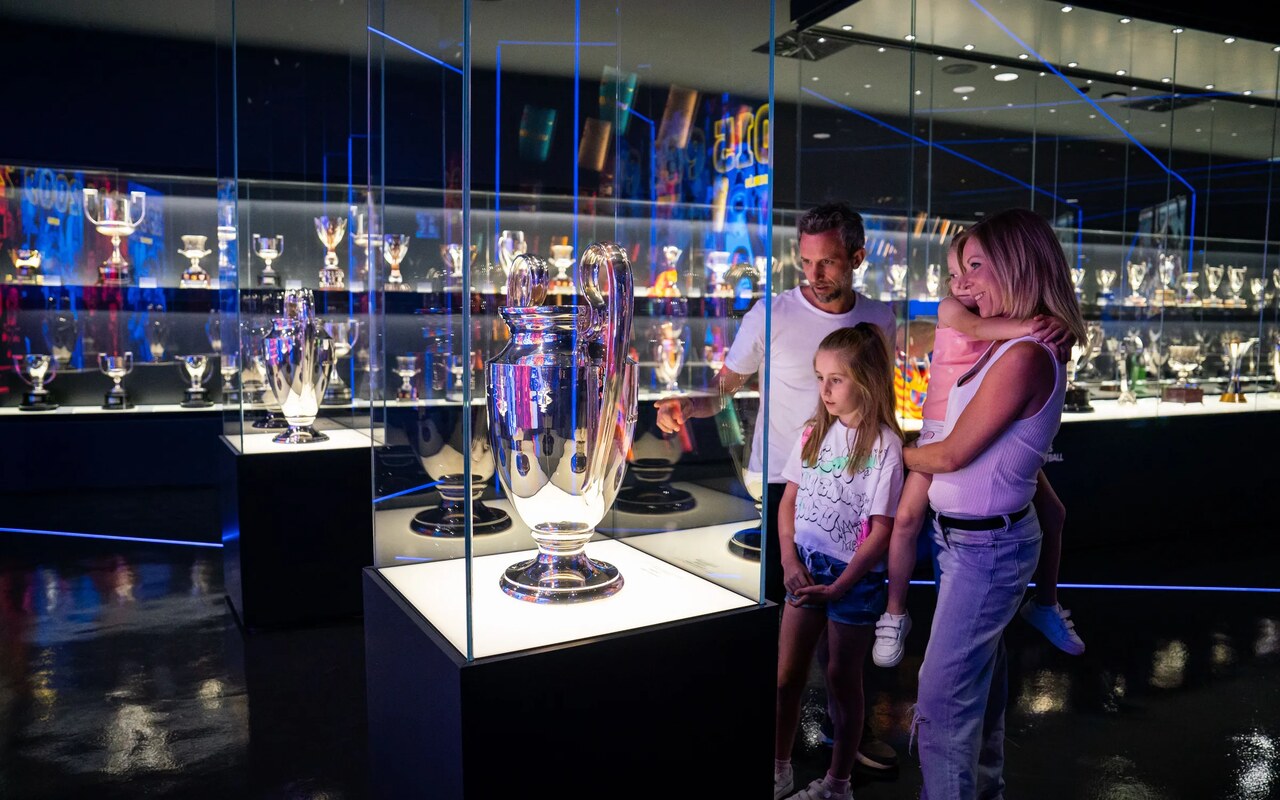
You can see it at the Barça Museum, where the rise of Barça Femení, and the Ballon d’Or years of Alexia Putellas and her teammates, sit alongside a century of club history. And you can see it live. The team’s big nights are increasingly played next door, at the Camp Nou. Their regular home is the smaller Estadi Johan Cruyff, just outside the city, one of the few places left where elite football still feels close, affordable and local.
The girl from Mollet started with bruises, sand and a motorbike. The next one might be sitting in the stand.